Between the Beat and the Body: The Unspoken Language of Live Dance-Music Collaboration
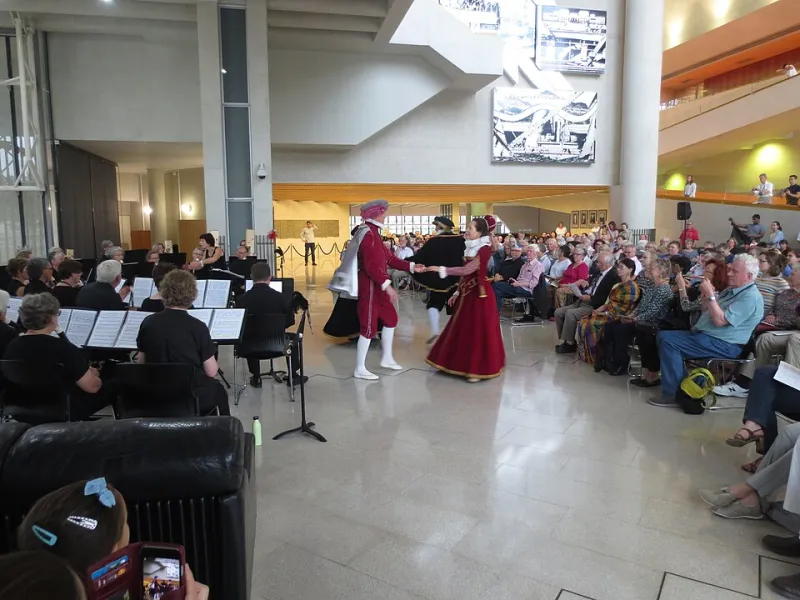
Photo: Johnscotaus, CC BY-SA 4.0, via Wikimedia Commons
There is a moment — familiar to anyone who has witnessed it from the wings or the front row — when a dancer and a live musician cease to be two separate artists and become a single, breathing entity. The cellist's bow lifts almost imperceptibly, and the dancer's torso responds before the next phrase has technically begun. The audience rarely identifies the mechanism. They simply feel the room change.
This phenomenon is not accidental. It is the product of rigorous preparation, neurological attunement, and a form of artistic negotiation that bears little resemblance to the scripted rehearsal processes most audiences imagine. Understanding how it works illuminates not only the craft of performance but the deeper science of human creative connection.
The Myth of the Fixed Score
Conventional wisdom holds that dance is choreographed to music — that the movement is mapped onto an existing sonic architecture and rehearsed until the relationship becomes automatic. This model describes the majority of concert dance productions, particularly those relying on pre-recorded soundtracks. However, when live musicians enter the equation, the entire paradigm shifts.
Rather than movement conforming to music, the two elements enter into what many practitioners describe as a continuous negotiation. Choreographers who work regularly with live ensembles are emphatic on this point. The score is not a fixed contract — it is closer to a shared grammar, a set of agreed-upon possibilities from which both parties draw in the present tense of performance.
This distinction matters enormously from a performance science perspective. Research into embodied cognition suggests that when performers operate within a system of genuine responsiveness rather than predetermined synchronization, their proprioceptive awareness sharpens, their decision-making accelerates, and their expressive range expands. The body, in other words, performs differently when it knows the sound beneath it is alive.
Rehearsal as Listening Laboratory
The rehearsal process for live dance-music collaboration looks markedly different from standard production schedules. Where a conventional rehearsal might focus on precision and repetition — drilling a sequence until it becomes muscular memory — a live collaboration rehearsal functions more like a structured improvisation workshop.
Many choreographers working in this mode dedicate the earliest rehearsal sessions exclusively to what might be called listening without moving. Dancers sit or lie in the rehearsal space while musicians play through material. No steps are set. The directive is simply to register: how does this phrase land in the body? Where does the rhythm suggest weight? Where does the melody invite suspension?
This practice is grounded in research on auditory-motor coupling, the well-documented tendency of the human motor system to entrain to rhythmic auditory stimuli. By allowing dancers to absorb sonic material kinesthetically before translating it into visible movement, choreographers are essentially priming the nervous system for faster, more intuitive response during performance.
Subsequent rehearsals introduce what practitioners sometimes call permission structures — agreed-upon signals between dancer and musician that authorize departures from the notated plan. A sustained exhale from a dancer might communicate a desire to extend a phrase. A subtle shift in a musician's dynamic might invite the dancer to alter spatial direction. These signals are rarely codified in writing. They emerge organically through accumulated hours of shared attention.
Trust as Technical Infrastructure
It would be a mistake to treat the interpersonal dimension of these collaborations as merely atmospheric. Trust, in the context of live dance-music partnership, functions as genuine technical infrastructure — as load-bearing as any set piece or lighting cue.
The vulnerability inherent in live responsiveness is considerable. A dancer who commits to following a musician's spontaneous variation is, in effect, releasing control over a portion of their performance. A musician who responds to a dancer's unexpected spatial choice is departing from the agreed arrangement in real time, with no opportunity for revision. Both acts require a confidence in the other's competence and intentionality that cannot be manufactured through brief acquaintance.
This is why the most celebrated dance-music collaborations in American contemporary performance tend to be long-term partnerships. The choreographer and composer have often worked together across multiple productions, developing what amounts to a shared performance dialect — an accumulation of micro-agreements, aesthetic preferences, and mutual understanding that makes spontaneous communication legible.
The parallel to ensemble jazz is instructive here. The most transcendent moments in jazz improvisation emerge not from individual virtuosity but from collective listening — from a group of musicians who know each other's tendencies well enough to anticipate without predetermining. Live dance-music collaboration operates on a structurally identical principle.
The Audience's Role in the Living Equation
What audiences perceive during a successful live collaboration is, neurologically speaking, a form of contagion. Mirror neuron research has consistently demonstrated that witnessing coordinated human movement activates the same neural pathways as performing that movement. When an audience observes a dancer and musician in a state of genuine mutual responsiveness, they are not passive recipients of a product. They are, in a meaningful physiological sense, participants in the exchange.
This is part of what distinguishes live collaborative performance from its recorded or pre-scored counterparts. The knowledge — conscious or not — that the dancer is responding to sound being made in real time, and that the musician is responding to movement being generated in real time, introduces an element of authentic uncertainty that recorded performance cannot replicate. Something is at stake. The outcome is not entirely known. And that quality of genuine risk is precisely what allows a performance to transcend technical execution and become something that lingers in the body long after the house lights return.
Toward a New Vocabulary of Partnership
As performing arts organizations across the United States continue to invest in live musical programming — recognizing that audiences hunger for the irreproducible quality that only live performance provides — the question of how to cultivate genuine dance-music collaboration becomes increasingly urgent.
The answer, based on both practice and emerging research, appears to lie less in technique than in time. The rehearsal strategies, the listening laboratories, the permission structures — all of these are valuable. But they serve a deeper process: the slow construction of a shared perceptual world between two artists.
When that world is sufficiently built, something remarkable becomes possible. The beat and the body cease to follow each other and begin, instead, to arrive together — not because they have been synchronized by external design, but because they have learned, through sustained attention and accumulated trust, to want the same thing at the same moment.
That convergence is what audiences recognize, even when they cannot name it. It is the thing that makes a performance feel, as the best performances do, not like something being shown to them, but like something happening for the first time — unrepeatable, fully present, and alive.