The Eloquence of Stopping: How Stillness Became Dance's Most Radical Statement
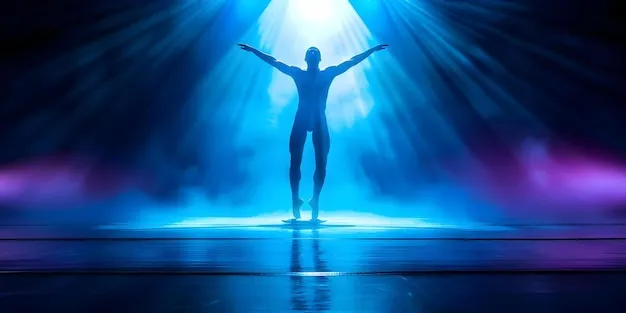
Photo: contemporary dancer holding still on stage dramatic lighting, via img.freepik.com
There is a particular kind of tension that settles over an audience when a dancer simply stops. Not stumbles, not transitions — stops. The music may continue beneath them. The lighting may shift. But the body remains fixed, a human sculpture occupying the stage with an almost unbearable intentionality. For many viewers, this moment produces something unexpected: not boredom, but a heightened alertness, a sudden awareness of their own breathing.
This is the architecture of stillness, and it is quietly revolutionizing how contemporary choreographers conceive of movement itself.
Motion as Assumption, Stillness as Argument
The conventional understanding of dance rests on an implicit contract between performer and audience: bodies will move, and audiences will watch them move. This agreement is so deeply embedded in Western performance culture that its violation — however brief — registers as a kind of productive shock. When that contract is suspended, the audience is forced into a different mode of engagement entirely.
Neurologically, this shift is well documented. Research in audience perception has demonstrated that unexpected stillness in a kinetic context triggers what some cognitive scientists describe as a "predictive mismatch" — the brain, having modeled what should happen next, encounters instead an absence. Rather than disengaging, attention sharpens. The viewer leans forward, metaphorically if not literally, scanning the performer's face, the tension in a shoulder, the barely perceptible rise of a chest.
Choreographers who work deliberately with stillness understand this mechanism intuitively, even when they lack the clinical vocabulary to describe it. They are, in effect, weaponizing the audience's own anticipatory cognition.
The Technical Demands of Not Moving
It is a persistent misconception that stillness requires less of a performer than movement. In practice, the opposite is frequently true. Holding a position with genuine presence — without the micro-adjustments, the subtle weight shifts, the habitual fidgeting that characterizes ordinary human stillness — demands extraordinary muscular control and psychological discipline.
Professional dancers who specialize in contemporary work often describe the challenge of "active stillness" as one of the most demanding skills in their repertoire. The body must remain dynamically engaged: core stabilized, breath regulated, gaze directed with precision. Any collapse of that internal engagement reads immediately to an audience as dead time rather than charged pause. The difference between the two is not visible in any single frame but is palpable across the duration of the moment.
This distinction — between inert stopping and intentional stillness — is central to understanding why the technique functions as art rather than accident. A performer who has genuinely inhabited the pause communicates something through sheer physical presence that no amount of choreographed movement could replicate. The stillness becomes, paradoxically, the most kinetic moment in the piece.
Philosophical Roots and Contemporary Practice
The intellectual lineage of stillness as artistic strategy reaches back through multiple traditions. In Japanese Noh theater, the concept of ma — often translated as negative space or meaningful interval — has governed the relationship between action and pause for centuries. American postmodern choreographers of the 1960s and 1970s, particularly those associated with the Judson Dance Theater in New York City, challenged the primacy of virtuosic movement by incorporating pedestrian stillness into formal performance contexts.
What distinguishes the current generation of choreographers is not their discovery of stillness but their increasingly sophisticated deployment of it. Today's practitioners are not simply inserting pauses as rest points or dramatic punctuation. They are constructing entire compositional architectures in which stillness functions as a primary expressive element — sometimes occupying as much stage time as movement itself.
Some works emerging from contemporary American dance companies now open with extended periods of motionlessness, inviting audiences to recalibrate their expectations before a single phrase begins. Others use stillness as a form of accumulation, with performers freezing in sequence until the stage holds a tableau of suspended figures, each one a concentrated point of attention. The effect is less like watching a painting than like standing inside one.
What the Audience Brings to the Pause
One of the most significant functions of strategic stillness is the space it creates for audience projection. When a body moves, it proposes meaning — it directs interpretation through the specificity of gesture. When a body stops, it opens a question. Viewers fill that question with their own emotional histories, their own associations, their own fears and longings.
This is not a passive process. It requires a kind of active spectatorship that faster, more densely choreographed work sometimes forecloses. In this sense, stillness is not merely a choreographic tool but a form of artistic generosity — an invitation for the audience to become co-creators of the work's meaning.
For arts communities across the United States, particularly those attending performances in intimate or mid-sized venues where proximity to the stage amplifies every nuance, this quality of invitation can be profoundly affecting. The experience of watching a performer hold absolute stillness from fifteen feet away is qualitatively different from observing the same moment from the rear of a large concert hall. Scale matters. Presence matters. The architecture of the space becomes part of the architecture of the silence.
Stillness as Cultural Resistance
There is also a dimension to this practice that extends beyond aesthetics into cultural statement. In a media environment defined by relentless acceleration — the infinite scroll, the algorithmic demand for constant novelty, the compression of attention spans — a performing body that refuses to hurry carries an inherently oppositional charge.
To stand still on a stage, in full view, without apology or explanation, is to assert that the present moment is sufficient. It is to resist the cultural pressure to produce, to entertain, to deliver the next thing before the current thing has been absorbed. Some choreographers have spoken explicitly about this dimension of their work, framing stillness not merely as a formal choice but as a philosophical stance — a refusal, enacted through the body, of the terms by which contemporary life demands our attention.
For audiences who carry the weight of that acceleration into the theater with them, this refusal can arrive as something close to relief.
The Measure of a Pause
Ultimately, what makes stillness powerful in performance is the same thing that makes it demanding: it cannot be faked. A dancer can execute a technically proficient turn without genuine engagement. Stillness, by contrast, exposes everything. There is nowhere to hide in the pause, no velocity to generate momentum, no sequence to follow. There is only the performer, the space, and the accumulated meaning of everything that has preceded that moment.
When it works — when the stillness is inhabited rather than merely held — it produces an experience that audiences carry out of the theater with them. Not the memory of a particular step or sequence, but the memory of a moment when time seemed to reorganize itself, when the stage contracted to a single point of absolute attention, and when the absence of movement became, somehow, the most moving thing of all.