Illuminated: The Invisible Architecture That Gives Dance Its Soul
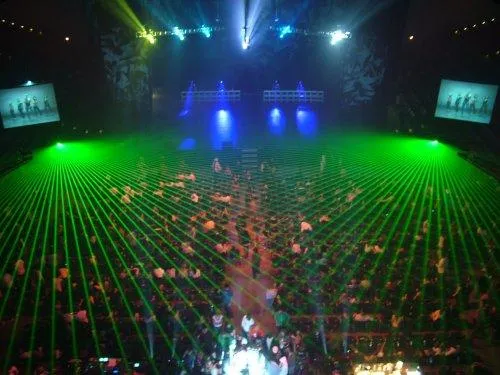
Photo: Dbizzy, Public domain, via Wikimedia Commons
There is a particular moment in a live dance performance that audiences rarely consciously register, yet almost universally feel. It arrives when the stage dims to a single pool of amber, or when a harsh diagonal shaft of white bisects a dancer mid-gesture. In that instant, something shifts — not in the movement itself, but in the meaning surrounding it. The body has not changed. The music has not changed. Only the light has. And somehow, everything is different.
This is the quiet dominion of the lighting designer: a discipline that operates in the margins of public recognition while exercising an authority over emotional experience that few other theatrical elements can match.
The Dramaturgy of Light
To understand what lighting designers actually do, it is necessary to move past the assumption that their work is fundamentally technical. Certainly, there are consoles, cables, gel filters, and programming sequences involved — the infrastructure is considerable. But the intellectual and artistic labor that precedes all of that machinery is closer in nature to dramaturgy than engineering.
Lighting designers read scripts, study choreographic notes, attend rehearsals for weeks or months, and engage in sustained conversations with directors and choreographers about intention, atmosphere, and subtext. They ask the same questions a novelist might ask: What does this moment want the audience to feel? What should remain hidden? What contradiction needs to be held in tension?
In contemporary dance specifically, where narrative is often abstract and meaning emerges through association rather than linear storytelling, the lighting designer's interpretive role becomes even more pronounced. Without a spoken text to anchor the audience, light becomes one of the primary languages through which a production communicates its interior logic.
Color as Emotional Argument
The psychology of color in theatrical lighting has been studied with increasing rigor over the past several decades, and the findings align closely with what experienced designers have long understood intuitively. Cool blues and silvers tend to create sensations of distance, melancholy, or clinical detachment. Warm ambers and golds evoke intimacy, nostalgia, and organic vitality. Deep reds can read as danger, passion, or ritual depending on context. Greens carry an almost universal undercurrent of unease.
But skilled lighting designers resist the tyranny of the obvious. The most compelling choices frequently involve tension — a warm body moving through cold light, or a scene of apparent tenderness bathed in an unsettling violet. These contradictions force the audience into active interpretation, compelling them to reconcile what they see with what they feel. That productive discomfort is often where the most durable theatrical meaning resides.
Contemporary American dance companies working at the intersection of social commentary and movement — a tradition with deep roots in the legacies of figures like Alvin Ailey and Anna Halprin — have increasingly leaned into this tension. Lighting designers collaborating with these companies often describe their work as a form of ethical positioning: deciding what to illuminate is, in a very real sense, deciding what matters.
Shadow as Narrative Space
If light is one half of the equation, shadow is its indispensable counterpart. The architecture of darkness on a stage is as carefully constructed as the architecture of illumination, and it carries its own set of meanings.
Shadow creates depth, both literally and figuratively. A dancer whose face is partially obscured becomes simultaneously more mysterious and more universal — the audience projects its own emotional content onto the ambiguity. Silhouette, that most elemental of theatrical effects, strips a body down to its essential shape and gesture, removing the particularity of a specific performer and replacing it with something closer to archetype.
In many contemporary works, the shadow cast by a dancer becomes a kind of second character — a persistent companion, an alter ego, a past self that the body cannot outrun. This is not accidental. Lighting designers who work regularly in dance speak of choreographing the shadow as consciously as the choreographer works with the body itself.
Intensity, Rhythm, and the Time Dimension
Beyond color and shadow, lighting design engages a dimension that is often underappreciated: time. The rate at which a light fades, the sudden percussion of a blackout, the slow bleed of a new color washing over a stage — these are rhythmic events as surely as any musical phrase or choreographic sequence.
Experienced lighting designers think carefully about how their cues interact with the temporal structure of a performance. A slow fade lasting thirty seconds creates a fundamentally different emotional experience than one lasting three, even if the beginning and end states are identical. The duration of a transition is itself a form of expression.
This temporal dimension means that lighting design is, in a meaningful sense, a performing art. The console operator who executes cues in real time during a live performance is engaged in an act that requires the same quality of presence and responsiveness that a musician brings to a live score. Small variations in timing, almost imperceptible individually, accumulate into a texture that distinguishes a technically competent execution from a genuinely alive one.
The Collaboration Imperative
Perhaps the most significant shift in how lighting design is understood within contemporary dance is the growing recognition that it functions best — and most honestly — as a genuine collaboration rather than a service relationship.
The older model, in which a choreographer completed a work and then brought in a lighting designer to, in effect, make it look presentable, has given way in many leading companies to an integrated process. Lighting designers now frequently enter a project during its early developmental stages, contributing to conversations about concept and structure before a single step has been set. In some cases, the lighting itself becomes a generative element — a designer's proposal for how a particular scene might be illuminated sparks a choreographic idea that would not otherwise have emerged.
This collaborative model demands a different kind of professional relationship, built on mutual fluency. Choreographers who work most effectively with lighting designers tend to be those who can articulate emotional intention clearly without over-specifying visual outcomes. Lighting designers who thrive in these partnerships tend to be those who remain genuinely curious about movement and its possibilities, rather than simply executing a predetermined aesthetic.
Toward a Fuller Accounting
The audiences who fill theaters across the United States to watch contemporary dance are, in a sense, receiving the work of at least two artists simultaneously: the choreographer who composed the movement, and the lighting designer who determined the conditions under which that movement would be perceived. The experience of the performance — its emotional register, its pacing, its moments of revelation and concealment — is the product of that collaboration.
To fully appreciate what happens on a dance stage is to develop some literacy in the language of light: to notice when a color choice feels deliberate, when a shadow seems to carry meaning, when a blackout lands with the force of a statement. That noticing does not diminish the magic of a performance. It deepens it, revealing the extraordinary density of intention that the best theatrical work contains.
At Raiin Dance Theater, where we understand that movement becomes meaning through every element of the stage environment, the lighting designer belongs not in the footnotes of a program but at the center of our understanding of what dance is and what it can do.