Equal Voices: When the Orchestra Pit Stops Taking Orders
The traditional grammar of dance-theater production assigns a clear hierarchy to its creative elements. Choreography establishes the terms; music fulfills them. The composer—or, in the case of existing scores, the conductor and musicians—serves the movement, accommodating its timing, supporting its emotional arc, yielding when the dancing demands adjustment. This arrangement has produced extraordinary work over the past century and a half. It has also produced a systematic underutilization of what live music is actually capable of doing in the presence of live bodies.
A quiet but consequential shift is underway in a number of American dance companies, particularly those operating in the experimental and avant-garde spaces where institutional conventions carry less weight. The shift is simple to describe and complex to execute: composers and choreographers are working as genuine equals, developing their respective contributions in parallel rather than in sequence, with neither element predetermined to serve the other.
The results are disrupting longstanding assumptions about what dance-theater integration can achieve—and raising pointed questions about the power structures that have shaped the art form for generations.
The Conventional Arrangement and Its Costs
To understand what is changing, it is worth examining what has been standard practice. In most conventional production timelines, choreography is developed first, or at minimum, the choreographic vision is established as the primary creative framework before musical decisions are made. When original music is commissioned, the composer typically receives a brief—sometimes a detailed one—that describes the emotional content, tempo requirements, and structural needs of the work. The composer then creates within those parameters.
This arrangement is efficient and, in many respects, logical. It gives the production a clear spine. It reduces the risk of irreconcilable creative conflict late in the process. It allows the choreographer to work with musical placeholders—existing recordings, scratch tracks—while the permanent score is being developed.
But it also imposes a ceiling. When music is designed to serve movement that already exists, or that has already been conceived in sufficient detail to generate a compositional brief, the music can only ever be responsive. It cannot initiate. It cannot propose something the choreographer has not already imagined. The relationship is fundamentally asymmetrical, and that asymmetry limits both parties.
Musicians who work regularly in dance contexts describe a particular frustration: the experience of having a compositional idea—a harmonic shift, a textural change, a rhythmic disruption—that would be genuinely interesting if the choreography could respond to it, but which must instead be discarded because the movement is already fixed. The music becomes, in effect, a very sophisticated form of accompaniment: skilled, sometimes brilliant, but always secondary.
Parallel Creation and Its Demands
The model being explored by a growing number of companies inverts this dynamic, or rather, it dissolves it. Composer and choreographer begin their work at the same moment, with the same level of information: a shared thematic territory, perhaps a structural framework, but no predetermined hierarchy of creative authority. Each develops their contribution independently and in dialogue with the other, neither waiting for the other to establish terms.
This sounds straightforward. In practice, it is one of the more demanding creative arrangements in the performing arts. The absence of a predetermined hierarchy means that conflicts—inevitable in any collaborative creative process—cannot be resolved by appeal to established authority. When the composer's structural instincts and the choreographer's spatial instincts diverge, there is no default rule for which one yields. The resolution must be genuinely negotiated.
Companies that have practiced this model consistently report that the negotiation process, difficult as it is, produces creative outcomes that neither party would have reached independently. The choreographer is forced to articulate, with unusual precision, why a particular movement choice matters—not just what it is, but why it must be that and not something else. The composer is held to the same standard. The discipline of genuine justification, applied to both creative streams simultaneously, tends to produce work of unusual clarity and conviction.
What True Independence Reveals
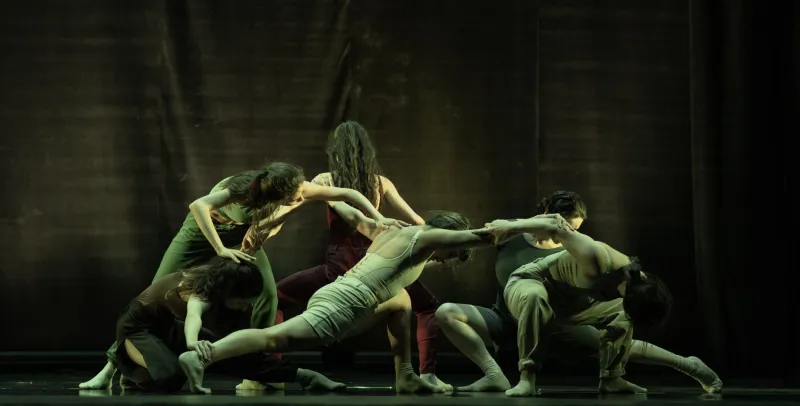
Perhaps the most striking aspect of the parallel-creation experiments underway in American dance theater is what happens when the two creative streams are allowed to diverge—when the music and the movement are not synchronized in the conventional sense, when they occupy the same space and time without one governing the other.
For audiences accustomed to the seamless integration of classical ballet or the tight musical-theatrical coordination of Broadway, this can initially feel disorienting. The familiar cues are absent: the swell of music that tells you this is the climactic moment, the rhythmic alignment that confirms the movement you are watching is intentional. In their place is something more ambiguous and, for many audience members, ultimately more engaging: the experience of watching two independent creative intelligences share a space and a moment, each fully itself.
This is, in some respects, closer to the experience of watching two improvisers than watching a conventional production. The relationship between what you hear and what you see is not predetermined; it is happening in real time, generated by the presence of both elements simultaneously. The audience becomes an active participant in making meaning from the relationship, rather than a passive receiver of meaning that has already been determined.
Power, Collaboration, and the Future of Integration
The questions raised by this movement in American dance theater extend beyond aesthetics. They are, at their core, questions about creative power and how it is distributed within collaborative art forms.
The conventional hierarchy of choreography over music did not emerge from a neutral assessment of artistic merit. It emerged from historical contingencies, economic structures, and cultural assumptions about which art forms and which practitioners carry authority. Examining that hierarchy—asking why it exists, what it produces, and what might be gained by replacing it—is an act of artistic and institutional self-examination that the best companies in this space are undertaking with considerable seriousness.
What they are finding, consistently, is that the distribution of creative authority is not a zero-sum question. When composers gain genuine creative independence, choreographers do not lose something. They gain a collaborator who is fully present, fully invested, and capable of surprising them in ways that a subordinate cannot. The work that results carries the marks of genuine encounter: two distinct creative intelligences, neither absorbed by the other, both changed by the meeting.
For a performing art whose defining subject is the relationship between bodies in space, the possibility of a music that is equally itself—equally present, equally unscripted—represents not a departure from the form's essential nature but a deeper expression of it.