From Wound to Stage: The Quiet Alchemy of Trauma-Informed Choreography
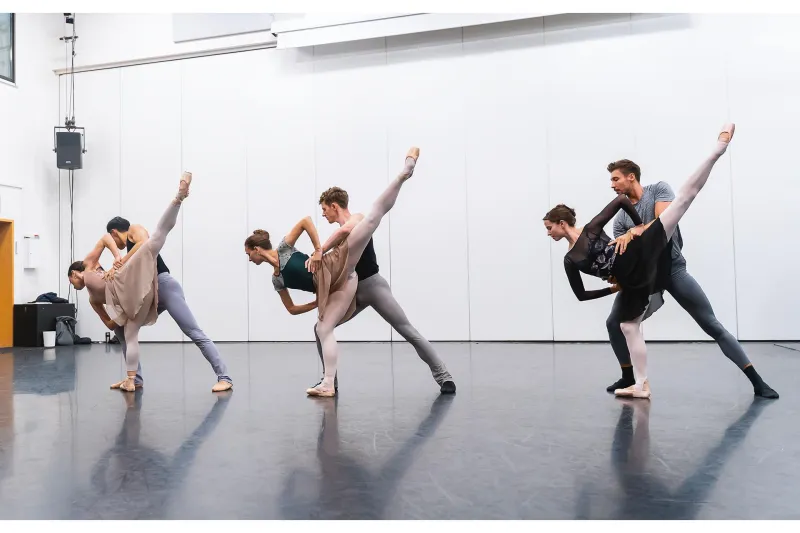
Photo: choreographer writing notes in rehearsal studio dancers in background, via northernballet.com
Some of the most powerful choreographic works of our time did not begin in a studio — they began in silence, in grief, in the aftermath of something irreversible. Across the American dance landscape, a growing number of movement directors are confronting the profound ethical and artistic challenge of translating deeply private suffering into performances that speak to audiences they have never met. What does it mean to make pain legible through the body, and who bears the cost of that translation?
The Notebook Before the Studio
For many choreographers, the creative process begins not with movement, but with language. Before a single step is set, there are journals, voice memos recorded at odd hours, and fragments of memory pinned to rehearsal room walls. This preliminary excavation — what some practitioners describe as "mapping the interior" — serves a purpose that is as much psychological as it is artistic.
The choreographer's notebook is rarely a polished document. It is, by design, a space of disorder: contradictions sit alongside certainties, half-formed images press against clinical recollections. What emerges from this private archive is not a blueprint for a dance, but a vocabulary — a set of physical metaphors that can bear the weight of experience without collapsing under it.
This distinction matters enormously. The goal of trauma-informed choreography is not to re-enact suffering. It is to distill it — to find the gesture, the rhythm, the spatial relationship that carries emotional truth without demanding that the audience witness raw, unprocessed pain. The difference between catharsis and exploitation, many practitioners argue, lives precisely in that act of distillation.
The Ethics of Visibility
Making private struggle visible in a public space introduces a set of responsibilities that extend well beyond the artistic. When a choreographer draws on personal trauma — whether rooted in loss, illness, racial violence, or familial rupture — they are not working in isolation. Their experience is entangled with the experiences of others: family members who may not have consented to representation, communities whose collective wounds are invoked, and performers who are asked to embody material that may resonate uncomfortably with their own histories.
The question of consent — both explicit and implicit — has become a central concern in contemporary American dance. Who has the right to tell a story through movement? When does personal testimony become a claim on shared experience, and when does that claim risk appropriation or misrepresentation?
Thoughtful choreographers tend to approach these questions not as obstacles, but as generative tensions. The friction between the individual and the communal, between the specific and the universal, is often precisely what gives trauma-informed work its power. A piece about one person's experience of displacement, for instance, may speak with particular force to audiences navigating their own forms of rootlessness — not because the experiences are identical, but because the choreography has found the emotional frequency that connects them.
The Performer as Collaborator, Not Vessel
One of the most significant shifts in contemporary choreographic practice concerns the relationship between the director and the dancer. The older model — in which a choreographer imposed a fixed movement score upon performers expected to execute it with technical precision — has given way, in many studios, to something considerably more collaborative.
When the source material is traumatic, this shift becomes not merely preferable but necessary. Asking a dancer to inhabit choreography drawn from another person's grief without attending to the emotional and psychological implications of that task is, many practitioners now acknowledge, an ethical failure. The rehearsal room must become a space in which the performer's own responses — their resistances, their resonances, their boundaries — are actively incorporated into the work.
This does not mean that every piece of trauma-informed choreography is autobiographical for its performers. It means that the process of making the work must account for the full humanity of everyone in the room. Some companies have begun integrating somatic practices, licensed mental health consultants, and structured debrief sessions into their rehearsal processes — recognizing that the body holds not only the choreographer's story, but the stories of those who carry it.
When the Personal Becomes the Universal
There is a paradox at the heart of trauma-informed choreography that its most skilled practitioners have learned to inhabit rather than resolve. The more precisely a work is rooted in specific, particular experience — the more uncompromisingly it refuses to generalize — the more likely it is to achieve genuine universality.
Audiences do not connect with abstraction. They connect with specificity: the particular quality of a hand releasing, the exact tempo of a body folding inward, the way silence accumulates in a theater before a figure finally moves. These details, drawn from the lived texture of an individual's experience, are what allow a stranger in a darkened house to feel, briefly and powerfully, that they are not alone.
This is the quiet alchemy that distinguishes the most enduring work in this tradition. It does not ask audiences to have suffered in the same way. It asks them only to recognize — in the precision of a movement, in the architecture of a pause — something true about the experience of being a body in the world.
The Long Work of Integration
For choreographers who work in this mode, the completion of a piece rarely signals the end of the process. Many describe a sustained period of integration that continues long after a production has closed — a reckoning with what was exposed, what was transformed, and what remains unresolved.
This ongoing relationship with the material is not a sign of incompletion. It is, rather, evidence of the seriousness with which these artists approach their subject. Trauma, by its nature, does not conclude. It shifts, resurfaces, and recontextualizes itself across time. Choreography that engages honestly with this reality must, in some sense, remain open — capable of being revisited, restaged, and reinterpreted as the artists who made it continue to change.
What the American dance community is slowly coming to understand is that this kind of work is not a niche practice or a therapeutic exercise dressed in artistic clothing. It is one of the most demanding and consequential forms of creative labor available to a movement artist — a sustained act of translation between the interior life and the shared world, conducted in full view of anyone willing to watch.