The Ground Beneath the Art: Inside the Quiet Engineering That Saves Dancers' Bodies

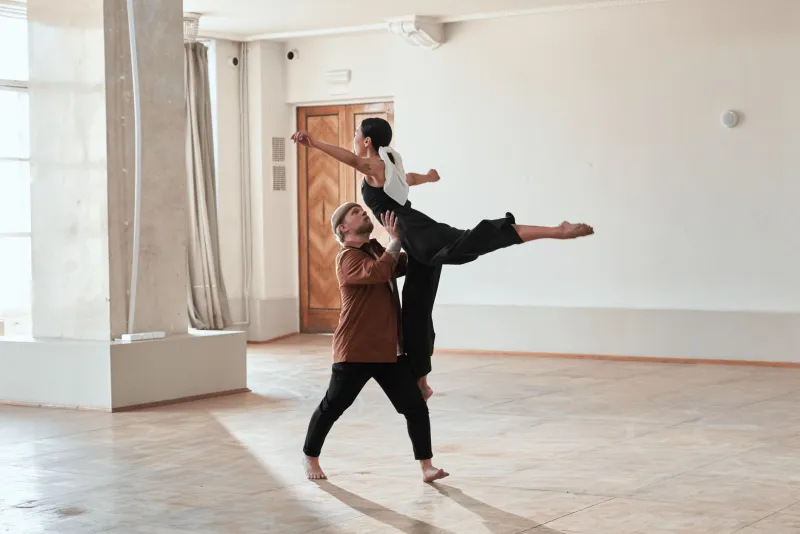
Photo: Solomon203, CC BY-SA 4.0, via Wikimedia Commons
The audience sees the leap. The critics praise the extension, the ballon, the seemingly weightless suspension at the top of a grand jeté. Almost no one—not the reviewers, not the donors in the front row, not even most of the dancers themselves—thinks seriously about what happens a fraction of a second later, when 140 pounds of trained muscle and bone comes back down to earth.
But somewhere below the marley, below the plywood, there is an answer to that question. And whether that answer is kind or cruel depends on choices made months earlier, in warehouse conversations about wood species, deflection rates, and pennies per square foot.
A Floor Is a Machine
Ask a stagehand what a dance floor is and you will likely hear about surface—slip resistance, seam tape, the daily ritual of mopping down marley with rosin solution. Ask a biomechanist and you get a very different answer: a dance floor is a spring, deliberately engineered to absorb a portion of every impact and return it, gently, as the dancer pushes off again.
The technical term is a "sprung floor," and its principle is elegantly simple. Rather than allowing a landing to compress rigidly against concrete—a surface that returns nearly all impact force straight into joints—sprung floors flex. Foam pads, basket-weave wooden slats, or elastomer blocks beneath the subfloor give way under load, spreading the deceleration of a landing over a few additional milliseconds. That sliver of time is not dramatic. It is, however, the difference between a career that lasts twenty years and one that ends at twenty-six.
"Dancers land with forces several times their body weight," explains one touring physical therapist who has worked with regional companies across the Midwest. "A proper floor doesn't eliminate that. It just refuses to hand all of it back."
The Budget Meeting Where Careers Are Decided
What makes sprung floors remarkable is not the physics—it is that anyone bothers at all. A sprung floor is invisible to every ticket buyer. It photographs exactly like a cheap floor. It appears in no review. And it can add tens of thousands of dollars to a renovation budget that is already stretched past reason.
This is where company managers earn their salaries in ways no one will ever applaud. In one typical scenario replayed in venues across the country, a theater must choose between a full basket-weave hardwood system, a less expensive foam-pad build, or a surface-only retrofit laid over the existing stage. The difference in up-front cost can be enormous. The difference in injury rates, studies suggest, is also enormous.
The wood itself becomes a subject of near-obsessive deliberation. Oak for hardness. Maple for its familiar resilience, the same species that carries a century of basketball players. Southern yellow pine in certain engineered systems. Each choice shifts the feel underfoot by fractions that dancers can perceive immediately, even if they cannot always articulate why.
"Dancers will walk onto a new floor and know within two minutes," one veteran rehearsal director says. "They won't say 'deflection rate.' They'll say it feels dead, or it feels alive. They're reading the floor with their feet."
What the Research Says—and Doesn't
The science of dance flooring remains younger than the dancers it protects. Standards exist—the most widely referenced come from sports-construction bodies that specify shock absorption and vertical deformation for athletic surfaces—but dance imposes demands those standards never anticipated. A basketball court must protect a player landing from a rebound. A dance floor must protect a performer landing from a jump, then pivoting, then dropping to the floor in a slide, all in four seconds, in soft shoes or bare feet or pointe shoes.
Researchers in sports medicine have documented meaningful reductions in lower-limb injury on compliant surfaces, though the literature is honest about its limits: floors interact with footwear, with choreography, with fatigue, with the simple fact that dancers will push harder on a floor they trust. That last point may matter most. A dancer who believes in the ground beneath her jumps bigger. The floor, in other words, is not only protective equipment. It is permission.
The Invisible Craft
There is a small national community—floor builders, stage riggers, technical directors—who treat this work as a calling. They measure deflection with weighted gauges. They argue about the gap between subfloor and concrete. They crawl around under stages in the dark, checking that no joist has bridged the spring they so carefully built.
Their work follows a strange geography of American dance: the companies rich enough to build correctly, the university theaters that inherit decades-old stages, the converted warehouses where a touring contemporary company performs on whatever the building happened to have. The inequity is stark. The dancers most likely to be injured—underpaid, underinsured, working multiple jobs—are often the ones dancing over concrete.
Some in the field have begun framing floor quality as a matter of workplace safety rather than aesthetics, a labor issue hiding in plain sight. If a warehouse protects its workers with anti-fatigue matting, the argument runs, why does a dance company ask its artists to absorb their own impact?
The Thanks They Never Hear
No curtain call has ever honored a floor. But consider the arithmetic: a professional dancer may take several hundred thousand landings in a career. Multiply each by the small mercy of a few millimeters of give, and the sprung floor emerges as what it truly is—not scenery, not infrastructure, but a collaborator in every single step.
The next time a dancer seems to hang impossibly in the air before touching down softly, cleanly, as if gravity had been politely negotiated with, remember the people in the dark under the stage. They built the bounce. They will never take a bow. And that, perhaps, is the point: the finest engineering in the performing arts is the kind no one is ever meant to notice.