One Stage, One City: The Quiet Power of Dance to Rebuild What Divides Us
Photo: Internet Archive Book Images, No restrictions, via Wikimedia Commons
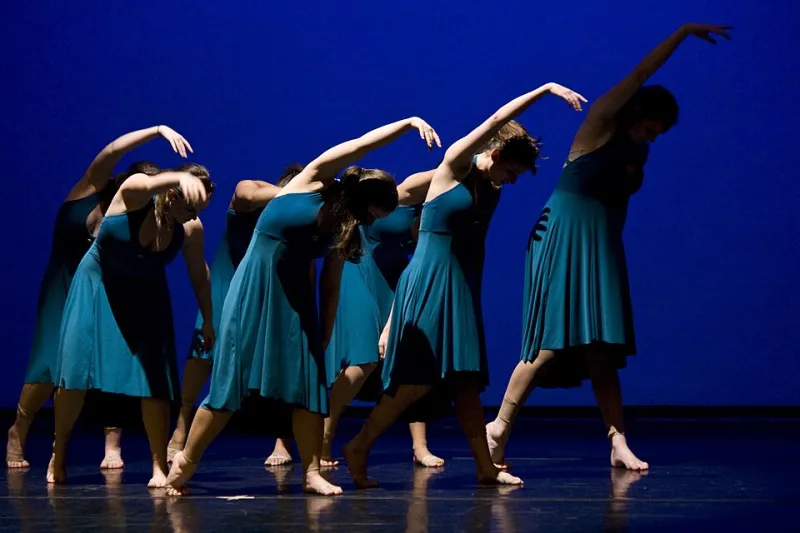
There is a moment — familiar to anyone who has sat in a darkened theater and watched a dancer reach the outer limit of what the human body can express — when the boundary between performer and witness dissolves. It is not a metaphor. Something neurological, something genuinely communal, occurs in that suspended instant. And according to a growing chorus of choreographers, sociologists, and community organizers working across the United States, that moment may be one of the most undervalued civic resources available to us.
In an era defined by digital fragmentation, algorithmic echo chambers, and the slow erosion of third spaces — those neutral gathering grounds where people encounter one another outside of work and home — live dance performance occupies a peculiar and increasingly precious position. It demands physical presence. It resists replication. And it offers something that no streamed content, however beautifully produced, can fully replicate: the experience of being moved alongside other people.
The Architecture of Shared Feeling
When a performance lands, it does not land on one person at a time. It lands on a room. This is not incidental to dance's power — it is central to it.
Researchers studying what is sometimes called "collective effervescence" — a term coined by sociologist Émile Durkheim to describe the heightened emotional energy generated when people gather around a shared experience — have found that live performing arts events are among the most reliable triggers of this state in contemporary life. Audiences at dance performances report not only personal emotional responses but a heightened awareness of the people around them: a sense, however fleeting, that they are part of something larger than themselves.
For choreographers working in community-embedded contexts, this is not an abstract phenomenon. It is the foundation of their practice.
"When we performed in the community center in South Side Chicago, the response wasn't just applause," recalled one choreographer who has spent the past decade creating site-specific work in underinvested neighborhoods. "People stayed for two hours afterward. They talked to strangers. They argued about what they'd seen. The performance gave them a shared language they hadn't had before."
That shared language — provisional, embodied, wordless at its core — is precisely what makes dance distinct from other communal art forms. A film can be paused and rewound. A painting can be approached and retreated from at will. But a live dance performance exists in real time, with real breath, and it pulls its audience into the same temporal current as the performers on stage.
Beyond the Theater Walls
The effects of a powerful performance rarely stay contained within the venue. Community organizers in cities from Detroit to New Orleans to Portland have begun documenting what might be called the social afterlife of live dance events: the conversations that continue at nearby restaurants, the increased foot traffic to local arts spaces in the weeks that follow, the measurable uptick in volunteerism and civic engagement among audience members who attended high-impact performances.
This is not coincidental. Psychologists studying the phenomenon of "awe" — that particular species of wonder triggered by encounters with something vast or transcendent — have found that it reliably produces what researchers call "prosocial" behavior. People who experience genuine awe are more likely to donate to community causes, more likely to describe themselves as part of a larger whole, and more likely to engage with people outside their immediate social circles.
Dance, at its most accomplished, is one of the most direct pathways to awe that public life affords.
"There's a reason ancient cultures put movement at the center of their communal rituals," observed one cultural anthropologist whose work focuses on performance and social cohesion in American cities. "We've intellectualized that impulse away, but the underlying wiring hasn't changed. When we watch a body move with full commitment and skill, something in us responds that predates language."
The Choreographer as Community Architect
For dance makers who understand this dynamic, the creative process extends well beyond the rehearsal studio. An increasing number of American choreographers now speak openly about their work in terms that would once have seemed more native to urban planning or community psychology than to the arts.
They conduct listening sessions in neighborhoods before a single step is set. They design post-performance conversations as carefully as they design lighting cues. They collaborate with social workers, educators, and faith leaders to ensure that the work they bring to a stage addresses — rather than appropriates — the specific textures of the communities they are entering.
This approach reflects a hard-won understanding: that a performance's capacity to foster belonging depends not only on what happens on stage, but on the entire ecosystem surrounding it. Who is in the room matters. How the room is arranged matters. Whether the audience feels invited or merely admitted matters enormously.
"We spent three months before our last production just talking to people in the neighborhood," said one artistic director whose company works primarily in communities that have historically had limited access to professional dance. "We wanted them to feel like the show belonged to them before they ever sat down. Because if they feel ownership, they don't just watch — they receive it differently. They carry it differently."
Belonging as a Performing Art
What these practitioners are describing, at its core, is a reconception of what dance performance is for. Not merely the presentation of virtuosity — though virtuosity has its own irreplaceable value — but the deliberate creation of conditions under which a group of people can feel, however briefly, that they belong to one another.
In a country where loneliness has been declared a public health crisis, where civic trust is at a historic low, and where the rituals that once organized collective life have frayed or vanished, this is not a modest ambition. It is, arguably, one of the most urgent tasks that artists can undertake.
The stage, in this framing, becomes more than a platform for expression. It becomes a kind of commons — a space where the usual hierarchies and divisions of daily life are temporarily suspended, where a shared act of attention creates, if only for an evening, something resembling a community.
That community does not always survive the walk to the parking lot. The pressures of ordinary life are quick to reassert themselves. But something persists. A memory of having felt connected. A face seen across a darkened theater and recognized, days later, on the street. A conversation begun in the lobby that continues, unexpectedly, for years.
This is the ripple that dance sends outward — not a wave, not a revolution, but a slow, steady, expanding circle of altered perception. And in a society that has forgotten how to gather with intention, that circle may matter more than we have yet allowed ourselves to believe.